Lee holds 7th press conference since taking office amid falling approval ratings
President Lee Jae Myung on Friday categorically ruled out seeking reelection, rejecting speculation that his push to revise South Korea’s Constitution to allow presidents to serve consecutive terms was intended to extend his own time in office.
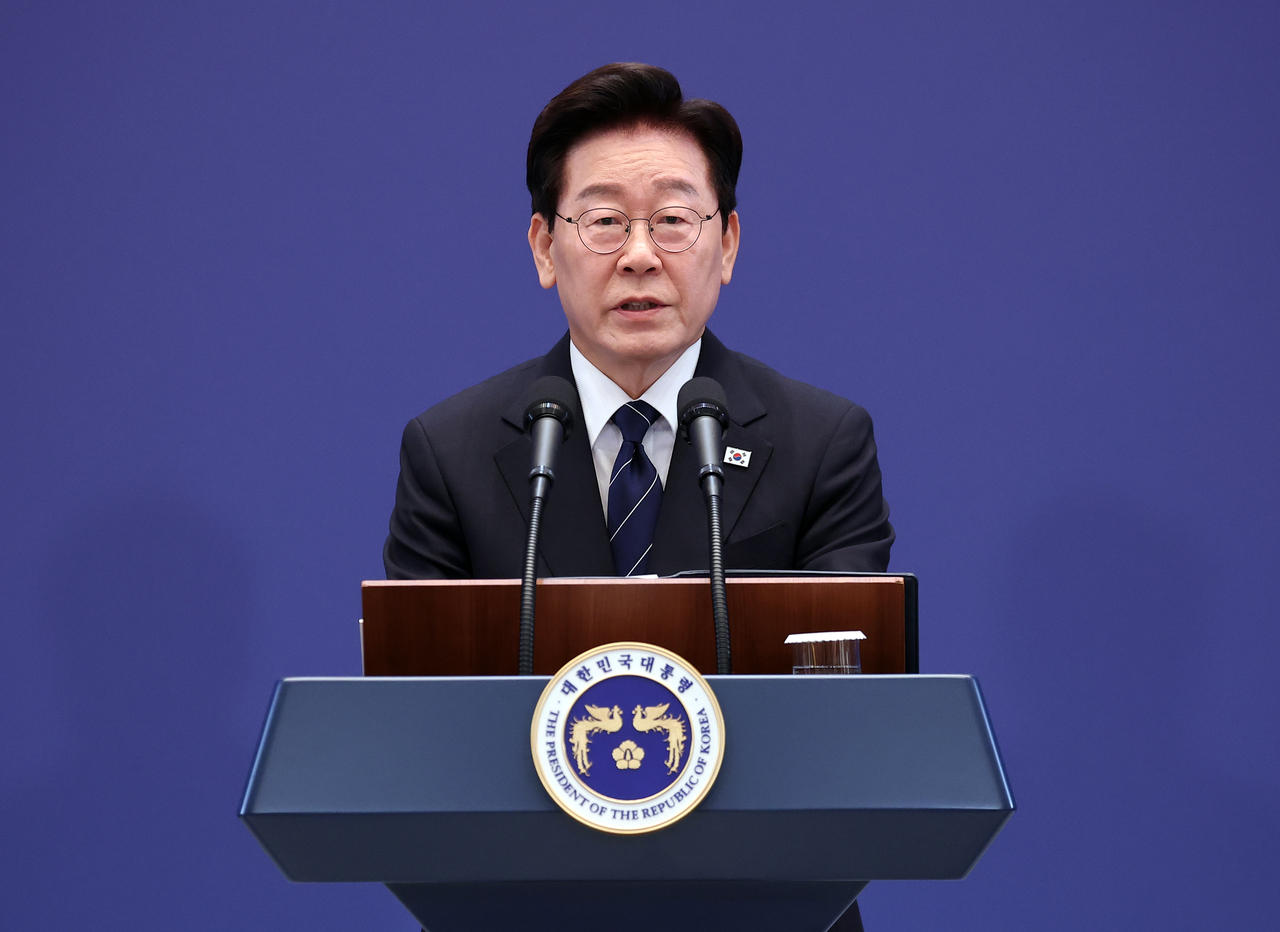
“I have absolutely no intention of seeking reelection,” Lee said during a special press conference at Cheong Wa Dae in Seoul, reiterating the point as he sought to address political controversies and public discontent that surfaced following the recent local elections.
Lee maintained his longstanding support for constitutional revision, including replacing the current single five-year presidential term with a system that would allow a president to seek another consecutive term, but stressed that such a change would not apply to him.
“I have repeatedly made clear through various channels that it would be constitutionally impossible for me to seek reelection through a constitutional amendment, and that I myself have never even considered doing so,” Lee said.
He said he had previously resisted demands that he explicitly pledge not to seek another term because he regarded them as a “political offensive” designed to create the impression that he had initially sought reelection before backing away from the idea.
“Nevertheless, I want to make it unequivocally clear once again on this occasion: I have absolutely no intention of seeking reelection,” he said.
Under Article 128 of the Constitution, amendments extending a president’s term in office or allowing a president to seek another term cannot apply to the incumbent president at the time the amendment is proposed.
Lee nevertheless stood by the case for revising the Constitution, arguing that the current charter, adopted in 1987 as South Korea transitioned to direct presidential elections, no longer adequately reflects the country’s political and social circumstances.
“The 1987 Constitution, which emerged as a product of compromise under the political circumstances of the time, is a garment that no longer fits the Republic of Korea today,” Lee said, referring to South Korea by its official name.
He pledged to pursue constitutional revision through discussions between the ruling and opposition parties and broader public consensus.
Lee said allowing presidents to serve consecutive terms could improve policy continuity and stability in state affairs.
He also dismissed speculation that he was seeking to introduce a parliamentary cabinet system or a semi-presidential system, calling such claims “completely groundless.”
The remarks came as Lee used the special press conference to respond more broadly to public dissatisfaction following the June 3 local elections, acknowledging shortcomings in his administration and pledging a more humble approach to governing.
“It is true that I was taken aback by what seemed to be a sudden wave of public disappointment and concern following the local elections,” Lee said. “But after spending considerable time reflecting and thinking deeply, I reached the conclusion that ‘the people are always right.’”
Though the ruling Democratic Party of Korea won 12 of the 16 major mayoral and gubernatorial races nationwide, it lost the politically symbolic Seoul mayoral contest and suffered defeats in several closely watched parliamentary by-elections. The election was also marred by ballot shortages at polling stations in Seoul that triggered public anger and protests. The ruling bloc subsequently saw its approval ratings decline.
Lee attributed the discontent to his own shortcomings, saying the urgency he felt in tackling a wide range of policy challenges had at times prevented him from sufficiently considering the concerns of those affected by the government’s agenda.
“With so many tasks before me, I was in too much of a hurry to adequately understand the feelings of more people,” he said.
He acknowledged that his focus on producing tangible results in areas including livelihoods, reform and national unity had left him insufficiently attentive to the conflicts and difficulties that accompanied those efforts.
Lee also conceded that “fear and humility” had diminished amid what he described as modest achievements and strong public support, pledging to approach state affairs with greater care and humility.
The president, however, signaled that the shift in tone would not mean retreating from key reform initiatives.
On prosecution reform, Lee vowed to “responsibly complete” what he called the historic task of making the changes irreversible. His administration has pursued a restructuring of the criminal justice system centered on separating investigative and prosecutorial powers.
The overhaul centers on abolishing the existing prosecution service and separating its investigative and prosecutorial functions. Under the new system set to take effect Oct. 2, the Serious Crimes Investigation Agency, under the Interior Ministry, will investigate seven categories of major crimes, while the newly established Prosecution Agency under the Justice Ministry will be responsible for indictments and prosecutions.
Lee said safeguards would be needed to ensure that removing investigative powers from prosecutors does not create gaps in protecting victims or the public’s rights.
He also sought to address concerns that concentrating investigative authority in the police could create another overly powerful law enforcement institution.
“Problems that could arise from the absence of prosecutors’ supplementary investigative authority will be addressed through rigorous checks and safeguards over police investigations,” Lee said.
He pledged “sweeping police reform” to prevent the police from becoming an unchecked center of power as their investigative role expands. Lee has previously called for stronger internal accountability and institutional changes within the police as part of his administration’s reform agenda.
“I will restore my sense of reverence for the people and approach everything with greater care, greater humility and greater determination,” Lee said.
Lee’s approval rating has declined steadily in recent weeks. A Gallup Korea telephone survey conducted Sept. 8-10 put his approval at 38 percent, marking a fourth consecutive weekly decline from 45 percent three weeks earlier, via 42 percent and 40 percent.
A separate Realmeter automated telephone survey conducted from Sept. 7 through Friday showed Lee’s approval at 33.8 percent, extending its decline for a ninth consecutive week.
mkjung@heraldcorp.com